
A decorative ceiling is about more than the tile itself. Borders, molding and finishing pieces help the ceiling relate to the rest of the room. Fillers finish the edges of patterned ceilings. Cornices and crown molding define the perimeter, while panel molding and ceiling medallions add architectural detail of their own.
Ceiling Tile Fillers
Ceiling tiles rarely land perfectly at every wall. Cutting a highly patterned tile to fit the remaining space can interrupt the design and leave an awkward fragment of the pattern along the perimeter. A filler gives the pattern a natural place to stop.
Fillers are often simpler than the main ceiling tile and can be cut to create a border between the decorative field of tiles and the wall. Some are plain or lightly textured, while molded fillers add another layer of detail. A border can also make a strong ceiling pattern easier on the eye. Giving the design a little breathing room around the edges lets the center stand out.

Tin Cornices
A cornice finishes the point where the ceiling meets the wall. Metal cornices are traditionally used with tin, aluminum and copper ceilings. They can conceal the cut edges of perimeter tiles while adding depth around the room, much as crown molding does with a painted ceiling.

The design does not have to be elaborate. A simpler cornice can quietly frame a patterned ceiling, while a wider or more decorative profile can become an important part of a traditional or historic-inspired room. Matching the cornice to the ceiling creates a continuous treatment. A contrasting finish can emphasize the border and make the ceiling feel more deliberately framed.
Faux Tin Cornice
Faux tin cornices offer a lightweight way to give a decorative ceiling a finished perimeter. Made from molded PVC rather than metal, they can coordinate with faux tin ceiling tiles while adding depth where the ceiling meets the wall.

Crown Molding
Crown molding can do more than hide the joint between the wall and ceiling. It frames the room and helps a decorative ceiling feel finished. The profile, scale and finish determine whether the effect feels ornate, classic or surprisingly simple. With a highly patterned ceiling, a quieter crown molding can provide just enough separation between the ceiling and the walls without competing for attention.

Beautiful Rooms Start with the Details
Substantial crown molding creates a clean transition between an ornate ceiling and the walls.
⬒ Antique Copper Ceiling Tiles ▥ Wood Wall Inset ▥ Panel Molding
Rather than choosing molding from a rigid formula based only on ceiling height, consider the proportions of the entire room. Smaller rooms or quieter ceilings may need only a restrained profile. Taller ceilings and larger rooms can usually support greater scale.
Lightweight Crown Molding
Lightweight foam crown molding is available in everything from simple profiles to more decorative traditional designs. Many styles are designed for glue-up installation and can be painted to blend into the wall and ceiling or become a more noticeable architectural detail.

If you are choosing molding online, samples can be especially helpful. A profile that looks substantial in a product photograph can feel completely different once you see its actual depth and proportion in the room.
Hand Painted Crown Molding
Hand-painted and specialty finishes can coordinate beautifully with metallic, aged or painted ceiling tiles, especially when you want the molding to become part of the ceiling design.


Ceiling Medallions
Ceiling medallions create a focal point around chandeliers, pendants and other ceiling fixtures. Depending on the profile, they can add a quiet architectural detail or become one of the most decorative elements in the room. A medallion can bring character to an otherwise simple ceiling, but it can also be layered with crown molding and other trim for a more detailed architectural look.

Beautiful Rooms Repeat the Details
The ceiling medallion draws the eye to the light fixture while repeated bow details carry the motif through the room.
⬒ Ribbon with Bow Ceiling Medallion ⬒ Federal Swag & Bow Panel Moulding
Panel Molding for Walls and Ceilings
Panel molding creates architectural detail in a different way. Instead of sitting only at the intersection of the wall and ceiling, narrow molding can be applied directly to a flat surface to create framed panels, borders or geometric designs. On walls, it can give an otherwise simple room subtle dimension without requiring full wall paneling. The Caputo Egg & Dart panel molding featured at the top of this page shows how much character a relatively small architectural detail can add. Painted the same color as the wall, the effect can feel especially clean and timeless.

Panel molding can also be used across the ceiling itself. Narrow strips of molding can frame a light fixture, define sections of the ceiling or create an entirely new geometric pattern overhead.
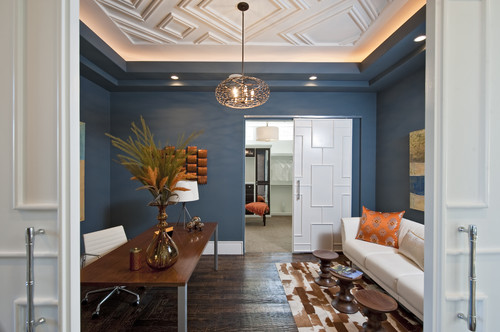
Architectural Inspiration
Panel molding turns a plain ceiling into an architectural feature by creating shape and dimension overhead.
The Details Matter
Decorative ceiling tiles naturally draw the eye upward, but the way the ceiling ends can be just as important as the pattern in the center. Choose the ceiling first, then consider how you want to frame it.
Make it a Beautiful Day!
2 Comments
M REFAI ARIFF, J P
July 15, 2011 at 3:22 pmPLEASE EMAIL ME YOUR CEILING MOULDING DESIGNS
admin
July 18, 2011 at 8:43 pmThank you for your interest in Decorative Ceiling Tiles. You can simply click here to see all your styrofoam crown molding options. Tin cornices are available here or just scroll down to the bottom of this page to see most of the available ceiling molding designs. Make it a beautiful day!